Home / Research

Research

Research at NexusFlow.

We study the layer around the model — where enterprise AI is actually won or lost.

Foundation models improve quickly. What lags is the discipline of putting them to work: knowing which model to trust for which task, coordinating agents without losing control, and proving to a regulator that the system behaves.

Our research program is applied and evaluation-first. We build methods we can measure, and we ship what survives measurement into the platform.


Research areas

Where we focus.

Area 01

Reliable model routing & evaluation

We study how to decide, per task, which foundation model to use — and how to evaluate that decision. Our work focuses on capability profiling, cost-aware routing, and benchmarks that reflect real enterprise tasks rather than generic leaderboards.

Area 02

Multi-agent coordination & supervision

Our work focuses on coordinating multiple specialized agents so that the whole is more reliable than any single agent — with supervision, verification, and human-in-the-loop control that keeps automations accountable.

Area 03

Multi-modal workflow reasoning

We study how to reason over text, documents, and vision within a single workflow — decomposing tasks into steps that can be checked, cached, and re-run deterministically where correctness matters.

Area 04

Governance & evaluation for enterprise GenAI

We study how to make model-driven systems observable and governable: tracing decisions, measuring drift, and building evaluation that gives enterprises evidence their AI behaves within policy.
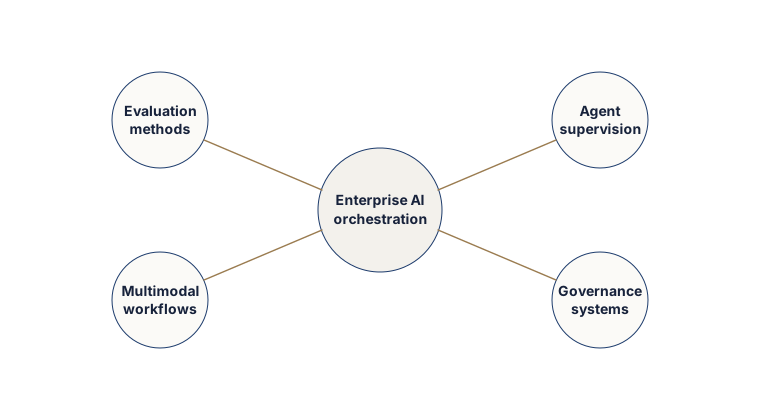
Research map: evaluation methods, agent supervision, multimodal workflows, and governance systems connect around a central enterprise AI orchestration node.
Fig. 1 — How our research areas connect around enterprise AI orchestration.
Technical notes

Perspectives & notes.

Short technical notes on how we think about orchestration. Longer write-ups are in preparation.

  • Note 01

    Routing as an evaluation problem

    Why choosing a model is really a measurement problem — and how we frame routing decisions as continuously evaluated hypotheses. Draft in preparation.

  • Note 02

    Supervision patterns for multi-agent systems

    A survey of the coordination and human-in-the-loop patterns we use to keep multi-agent automations reliable. Coming soon.

  • Note 03

    Observability for model-driven workflows

    What to trace, and why audit trails are a design requirement rather than an afterthought in regulated settings. Coming soon.

We collaborate with teams building on foundation models.

Research partnerships, applied pilots, and technical conversations welcome.

Get in touch